Writing Exhibitions, 7.9 Cubic Metres:
You Own Me Now Until You Forget About Me. | Kingston Upon Thames/UK

Writing Exhibitions

Writing Exhibitions was a two day event at the Stanley Picker Gallery in Kingston-Upon-Thames, on November 28 2009, exploring connections of language and exhibition making. The event was the concluding part of Guess Work Guest Work, an exhibition by David Berridge and Compulsive Holding (Hyun Jin Cho and David Johnson). For its final weekend, the exhibition was taken down, making the 7.9 Cubic Metre project space available for a series of micro-exhibitions – interventions, performances, screenings and displays which articulated some aspect of the relationships between language and exhibition making.

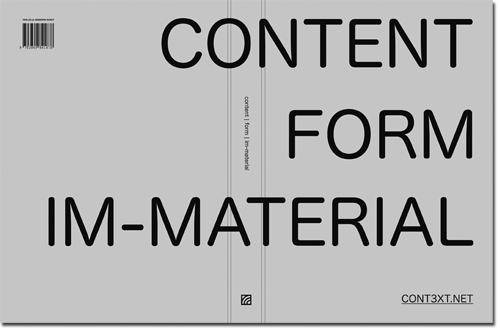
For this event I curated a series of micro-exhibitions by artists and groups not present in the space – Jonathan Keats, Alexander Hetherington, and CONT3XT.NET. Each was a different act of translation: Keats’ Experience Exchange was a participatory work originally designed for the commercial arena of the Berlin Art Fair; Hetherington’s A Million Lies; Once and Only Revealed After Death (Triangle of Need) involved adapting a large scale multi-screen performance installation for the spatial, temporal, technological and budgetary restrictions of the Writing Exhibitions event. The project with CONT3XT.NET sought to to create a new version of their exhibition You Own Me Now Until You Forget About Me.

What follows is a script I developed prior to the event, through email dialogue with CONT3XT.NET and my experience of the exhibition in various print and digital forms (I did not see Until You in either of its physical incarnations). I conclude with an account of how the script was necessarily transformed in the moment of its enactment, and some reflections on the whole process.

NOTE: Exhibition texts mentioned below can be found on the exhibition’s website. Photo documentation has been removed as inappropriate for this particular incarnation of the exhibition. Hyun Jin Cho made drawings of each of the micro-exhibitions, producing “invitation cards” or “posters” for each show whose time of production was often concurrent with the 20-minute show itself.

Hyun Jin Cho, You Own Me Now Until You Forget About Me., 7.9 Cubic Metres, 28/11/09

2. A CURATORIAL SCRIPT

A table on which all the materials of the exhibition are laid out: a series of A4 print outs, a catalogue, two black cushions, text on a clipboard. DAVID places the original announcement for the exhibition on the outside of the cube.

DAVID: (Reading aloud) You Own Me Now Until You Forget About Me., Museum of Modern Art Ljubljana 16 May- 22 Jun 2008; You Own Me Now Until You Forget About Me., Galerija Miklova, Ribnica 17 October – 10 November 2008; You Own Me Now Until You Forget About Me., 7.9 Cubic Metres, Kingston Upon Thames, 28 November 2009, (Checks time on mobile phone in pocket) 2.15pm.

Writing Exhibitions, Photo Documentation Removed #1

On the walls of the cube DAVID installs the links:

http://khjeron.de/?ELEMENT=1147

http://www.turbulence.org/Works/apartment/

http://codemanipulator.com/gallery/codemanipulators-works/Codemanipulator-HTML-Malevich-1996.jpg.php

http://katastrofsky.cont3xt.net/home/?p=104

http://twitter.com/netwurker/statuses/133392812

http://clitoressa.net/vlv/default.htm

DAVID: Should the presentation of these links be uniform?

The links are both handwritten and typed, on various types, colours and sizes of paper. Paper, card, pens, tape and scissors are also placed in the cube, along with a sign that says:

PLEASE EXTEND THIS EXHIBITION BY ADDING A LINK

DAVID: (Emerging from cube, picking up and reading text on clipboard) Thanks for getting in touch. It was good to read about your work. I’m very interested in the You Own Me Now Until You Forget About Me. project, as it seems to open the discussion about Writing Exhibitions into some new areas – about digital writing, and the status of the physical exhibition within that context.

I’m also curious about how these issues relate to someone, like myself, coming to your project later, not having seen any of the previous incarnations, and how this might relate to the 7.9 Cubic Metres space. My suggestion is that I use the catalogue of the show to create a “new version” of the exhibition within the 7.9 Cubic Metres space. I’m still thinking through what this means, and would welcome any thoughts. It would be about 15 minutes long and involve me installing some texts, reading and so on…

DAVID asks someone to read the following text aloud. During this reading DAVID holds up printed sheets of web links for all the words that are hyperlinked.

X1: One of the basic principles of Internet-based art and its re-formulation for the 7.9 cubic space could possibly be the different links to the artworks. In other exhibition contexts we worked for example with printed links – on walls, on business-cards, on flyers, etc. In this regard we did an interview with Jodi for our project CUREDITING – perhaps the following question/answer is interesting for you:

Question: Do you think it is appropriate to exhibit the link to an artwork as the representative of the artwork?

Answer: A net(.art)work can not exist without a link. A link is the address of a website, without that link the website would not appear, it is the start button and it is part of the actual work. It is the first line of code to activate a program. It filters out all the other sites. It is a piece of functioning code that is part of the work itself. It brings us from real space to the net.

DAVID: I think asking people to read texts aloud is, in this new context of 7.9 Cubic Metres, equivalent to these comments on web addresses. It demonstrates that this exhibition right now is now about language, reading and curating as social, public acts that set in process chains of communication. But, just as the code must be exact to work, my own process here is also potentially domineering and coercive…

On the remaining walls of the cube DAVID installs, in central position, the curatorial statement text and description of the works from the catalogue:

Writing Exhibitions, Photo Documentation Removed #1

DAVID places some black cushions in one corner and, at the eye level of someone sitting on the cushions, the “READING SPACE” text with its bibliography. DAVID maintains an audible verbal commentary on these actions.

DAVID asks someone to sit in the reading space and hands them a book, indicating a passage to be read aloud.

DAVID: Thank you X. This exhibition will now include X, who will be “reading” from Liz Kotz’s Words To Be Looked At: Language in 1960’s Art.

Writing Exhibitions, Photo Documentation Removed #3

Writing Exhibitions, Photo Documentation Removed #4

Writing Exhibitions, Photo Documentation Removed #5

Writing Exhibitions, Photo Documentation Removed #6

X: Physically modest and de-skilled, these scores represent an artistic practice driven by, but also counter to, the recording and reproductive technologies that would increasingly restructure sound and language in the post-war era. The project of semiotics is both an effect and a motor of this historical process, in which language, sound, image, and time become objects of decomposition, quantification, recombination, and analysis – an earlier phase of which is already evident in the breakdown of representation and sign in cubism and Dada. Yet the diverse techniques and technologies generated during World War II, from cybernetics and information theory to the perfection of magnetic audiotape markedly intensify this process, reducing complex information to transmissable series of binary digits, and proliferating indexical signs whose distance from syntax potentially reduces signification to “the mute presence of an uncoded event.” Under the pervasive pressure of (mechanical, electric, and later digital) technologies of recording, reproduction, and transmission, the perceptual conditions of explicitly temporal and repeatable media (phonograph, film, and later audiotape and videotape) come increasingly to inflect apparently static materials (objects, images, and printed text) in the postwar era, while also turning the previously ephemeral into a kind of object (for instance, the long playing record). Given its structural reliance on continual reenactment and its deep historical implication in systems of inscription, language is a special case, a kind of model – of which the event score is but one example…

Whilst X is reading aloud, DAVID invites people to enter the cube. DAVID also hands out of the following texts on slips of paper and invites people to read them aloud as members of a shifting “code choir”:

X1: encoded into zeros and ones and then decoded back into human language

X2: inspired by Cicero’s mnemonic technique of a memory palace

X3: establishes an equivalence between language and space by typing words and phrases

DAVID: (Interrupting) This exhibition will be ending shortly. Please make sure you have read everything. Please continue the exhibition by adding a link.

X4: allows the user to apply his or her individual rules so as to generate visual poetry

X5: endlessly reproduces the content of dynamic websites as hard copy

X6: single sheets of paper that contradict the standardisation of human life

DAVID: (Interrupting) The enactment of internet based art in the physical space means an enactment of something that is not physical. What you are thinking about doing in 7.9 Cubic Metres is one step further: you try to re-enact the physical enactment of something immaterial – by the means of language, spoken or written, in the form of an “installed reading of the catalogue”, in the form of “links on the wall or on flyers”, etc.

X7: a numbered but unsigned set of sentences

X8: confronted with signs, numbers, symbols and snippets of programming code -

DAVID holds up more handwritten signs of web links to the organizations that have been part of the You Own Me Now project in its various forms:

Writing Exhibitions, Photo Documentation Removed #7

DAVID reads a statement from the 7.9 Cubic Metres website on the theme of SLASH: ARTIST/ CURATOR/ ARTIST (by curator Eliza Tan):

DAVID: The late 50s saw the emergence of new exhibition models, artist-run spaces and curatorial practices defined by artist-curators. This provided an emancipatory model from institutional selection agendas, allowing the artist claim to agency not only for self-promotion, but to frame cultural material and curatorial agendas.

On another side of the spectrum, however, a question of positioning further arises with regards to curators empowered by “superstar” reputations. When does a curatorial agenda precede or eclipse an artist’s artistic motivations and conceptual intent? Should a curator be considered an artist?
The reading of the slips of paper has continued throughout.

X9: replacing the aesthetics of stylistic devices within a wide range of open semantic systems

X10: animating special characters in the form of vibrant female genitals

X11: an endless process of delimination and conjunction

DAVID: When you are ready please place your slip of paper in the cube. When everyone has done this the exhibition will be over. Thank you for being part of You Own Me Now Until You Forget About Me., 7.9 Cubic Metres, 28 November 2009, 2.15pm – (Checks phone and waits till last person places slip in cube) 2.35pm.

3. THE EXHIBITION AS IMPROVISED PERFORMANCE

As the preceding micro-exhibition concluded in a discussion, I began installing You Own Me Now Until You Forget About Me. I was feeling time was short at the end of a long day, but also unease about how the scripts wordiness and coercion would encounter its unsuspecting audience.

Web site addresses in a variety of formats were placed on the wall and on plinths left from the previous show. Some slips of paper were cut into strips ready for the “code choir” but, rather than being handed out, were left on a plinth, with scissors and a sheet of further sentences. The reading room became a book on a chair, fitting the show into the space that existed, using the script as a structure but also making any exact performance of it impossible.

7.9 Cubic Metres, Stanley Picker Gallery, designed by James Carrigan

For an introduction I read key quotations from my dialogue with CONT3XT.NET aloud. I announced “This exhibition is now open.” For 15 minutes people moved in, out, and through the space. A web site was added, slips of paper were taken from the plinth and placed around the room – on top of press releases for the show, for example, and on the cover of Liz Kotz Words To Be Looked At, creating playful collisions of materials. After 20 minutes I announced the exhibition was now closed.

4. POSSIBILITIES AND POTENTIALS

The following notes are necessarily propositional and inconclusive:

(A) The Materials of an Exhibition

Presenting an exhibition in this way foregrounds the materials of which it is composed. In the absence of the original art works, artists and (except by email) curators, this materiality is composed of: press releases, curatorial statements, and web pages.

Rather than foregrounding an engagement with the formal properties of an exhibition, this had the paradoxical effect of highlighting the exhibition as a living process, less a gathering of objects than a set of ideas and relationships that can take various spatial and temporal forms.

(B) The Nature of the Script

Once the exhibition is reduced to a set of materials, then the script becomes the architecture for those materials and a set of proposals concerning the relations between them. The script is a fantasy of relationality, its coercive intent a way of articulating often hidden power relations in the process of exhibition making.

The script has a range of possible relations to what is realized. It may be a closely followed set of actions, or something valuable for its contrast to what results; private working document or exhibited object. It may be adapted and changed at the last moment in response to changing circumstances, or be erased by the paradigm shift of the exhibition itself. As here, the exhibition is likely to necessitate the script’s re-writing.

(C) The Physical Experience of the Exhibition

The script operates between idea and object, event and frame, original and mimicry. The exhibition is between performance and event, conversation and observation, archeological dig and archive, with a physicality of its own beyond the presence or not of “original art works,” whether those are bronze sculptures or web addresses.

(D) The Aftermath

The micro-exhibition format offered new ways of initiating, developing and presenting an exhibition. The spatial and temporal restrictions opened up a productive space of research between idea and object, event and imitation. How can the the insights of such processes can be translated into more conventional curatorial situations? I am currently thinking about an exhibition that is a simultaneous oscillation between a gesture and its imitation, first person and third…

-