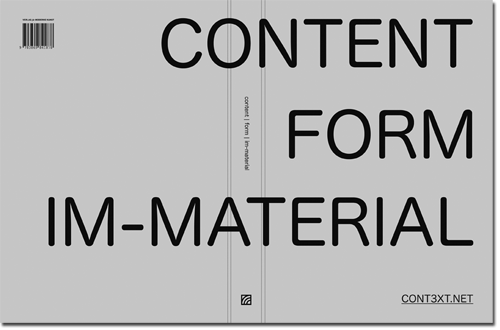
Group exhibition, Ljubljana & Ribnica/Slovenia:
You Own Me Now Until You Forget About Me.

Speech and the ability for meta-reflection on one’s own language are inherent characteristics of human beings. Since the beginning of the twentieth century, language — whether written, spoken, or performed—has become more and more a part of the visual arts in various artistic practices and theoretical approaches, ultimately becoming a constitutive element and the “source” code of digital art. All the projects presented in the exhibition YOU OWN ME NOW UNTIL YOU FORGET ABOUT ME. were originally Internet-based artworks. But the main thing they have in common is that they take as their starting point an exploration of language, with its arbitrary structures and rules, its various functions within society, its absurdities and constraints on the individual. Open processes are inherent to digital artworks, both in their production and in the mnemonic activities that emerge in their reception. Rather than focusing on the isolated — literary/literal — artwork, the exhibition highlights general artistic tendencies toward a discursive process that originates on the Internet and finds its way back to the “virtualities of real life”.
As the linguist Ferdinand de Saussure (1) explained, human language can be described under three fundamental aspects: the biological preconditions for speaking (langage); the fixed system of rules and signs based on collective convention (langue); and the act of speaking itself, as ephemeral and individual statements and utterances (parole). Saussure assumed that language can only be properly considered within the system of langue, not through parole, but such a division between social collectivity and individuality, between the general and the specific, does not hold when it comes to Internet-based art and its mechanisms. Quite the contrary, art on the Internet focuses on many interrelated practices of both the artist and the user, tracing individual experiences and questions back to a larger system, to society itself. Given the supposition that the language system — conceived as a collective institution of norms — and the speech act — conceived as an individual, coherent and meaningful utterance — are reciprocally linked and that there can be no backflow into the system without speaking, it becomes clear that human language eludes immediate observation. Language can be examined only by reconstructing the process of its appearance, its articulation. Viewing our system of communication from this angle, we must ask if language is, then, an exclusively virtual product whose existence begins and ends with its realisation.
By the same token, digital artworks, although predetermined by the binary (linguistic) code, do not become “real” (generally comprehensible) until the code is transformed into text, image, or sound (when the data file is opened and the commands executed). Both language and digital artworks are based on processes, transformations and continuous fluidity. In the digital realm, language (the binary code) acts like a set of hidden stage directions or commands about “how to do things with words”. (2) It can be thought of as a speech act that is realised through various media and that is part of an “infinite chain of acts of repetition, which cannot be grasped or controlled. […] Their peculiar, strange character is constituted by the fact that they refer to contexts that are not present in the moment they are actualised.” (3) The creation of digital artworks is founded on the active participation of a user, just as the existence of language is founded on the person who speaks. Text and image are considered to be humanity’s oldest mnemonic methods for preserving orality longer and bolstering memory. In the digital realm, the processual aspect of text and image, and therefore their own “orality,” renders mnemonic functions obsolete. Furthermore, text and image are not only equally constitutive elements, but they are also irreversibly interlinked: on the one hand, text and image are both based on text; on the other, the binary code must be visualised in order to be comprehensible and so disembogues in a kind of equalising formula: “language to be looked at and/or things to be read”. (4) The transformation of text into image, and vice versa, is not a reduction but a translation, and the question is not what is lost in translation, but what is gained.
In conclusion, to return to Saussure’s thesis, the words, images and sounds in digital art are no longer discrete parts of the artwork, and the langue and langage are no longer part of the parole. The individual elements of both systems are entangled in a performative act that renders interpretation obsolete. The “open work” (5) manifests itself through mediation and is created individually with each new reception of it. But what happens when the user closes the data file, when the speaking person stops talking? “In the end there is nothing of an object here, just a process, a set of rules that leads you to the point of questioning unicity, ownership, and the object-like nature of digital art works and what you can own is nothing more than the memory of it.” (6)
References
(1) See Ferdinand de Saussure, Course in General Linguistics, ed. Charles Bally and Albert Sechehaye with Albert Riedlinger, tr. Roy Harris (LaSalle, Ill.: Open Court, 1986).
(2) See John L. Austin, How to Do Things with Words (Cambridge, Mass.: Harvard University Press, 1975).
(3) Hartmut Winkler, Diskursökonomie: Versuch über die innere Ökonomie der Medien (Frankfurt am Main: Suhrkamp, 2004), quoted in
Peter Gendolla, and Jörgen Schäfer, eds., The Aesthetics of Net Literatur. Writing, Reading and Playing in Programmable Media (Bielefeld,
Germany: Transcript, 2007), 20.
(4) Robert Smithson used this phrase in a press release for a show at the Virginia Dwan Gallery in New York in 1967. See Robert Smithson,
The Collected Writings, ed. Jack Flam (Berkeley, Calif.: University of California Press, 1996).
(5) See Umberto Eco, The Open Work (Cambridge, Mass.: Harvard University Press, 1989).
(6) Luis Silva, Owning Netart for Free. Go for the Original, not the Copies (2005).
-

APARTMENT (2001)
By Martin Wattenberg & Marek Walczak
In Apartment (2001) Martin Wattenberg & Marek Walczak (with additional programming by Jonathan Feinberg) were inspired by Cicero’s mnemonic technique of a memory palace. The user establishes an equivalence between language and space by typing words and phrases. After being automatically processed, the language takes the form of a two-dimensional blue print projected onto the floor of the gallery that allows the visitor to walk “through” it. The semantic relationships of the written words are connected to spatial and contextual configurations, and at the same time cause their architectural re-organisation.
-

A LA RECHERCHE DU TEMPS PERDU (2005)
By Karl Heinz Jeron & Valie Djordjevic
In this 2005 performance by Karl Heinz Jeron & Valie Djordjevic, Marcel Proust’s novel À la recherche du temps perdu is first encoded into zeros and ones and then decoded back into human language – that is, processed from the analogue to the digital and back again. The zeros and ones are read by two persons alternately, then interpreted by a third, who represents a Central Processing Unit (CPU), and finally stuck onto a wall panel by a fourth as Display. The performers play computer with the ASCII-version of this originally literary text. In the gallery, in addition to the video documentation of the performance, a copylefted manual of instructions invites the visitor to continue the procedure at home.
-

HTML-MALEVICH (1996) & HTML-CSS-MALEVICH (2001)
By Codemanipulator®
Kazimir Malevich’s The Black Square marks a turning point in art history in that it is a synonym for the possibility of the artwork’s reduction. HTML-Malevich (1996) by Codemanipulator® intends to do the same by stripping the black square of its very “materiality”. In addition, the viewer is confronted with the historical dimension of using text code as painting: in a later re-interpretation of the artwork, HMTL-CSS-Malevich (2001), the size of the code is further reduced to a few lines by a newer standard of coding. Also, depending on the browser (the interpreter), the rendered results will be either Malevich’s square or his circle.
-

NAM SHUB WEB (2005-2008)
By Jörg Piringer
The website-processor nam shub web (2005–2008) by Jörg Piringer, originally based on the Internet, allows the user to apply his or her individual rules to the textual content of external websites so as to generate visual poetry. In the work’s gallery adaptation, a printer is installed that endlessly reproduces the content of dynamic websites as hard copy. Over time, the floor of the gallery is covered with single sheets of paper that contradict the standardisation of human life and the unification of culture through linguistic manipulation.
-

OBJECTS OF DESIRE (2005-2008)
By carlos katastrofsky
In objects of desire (2005–2008) by carlos katastrofsky, a numbered but unsigned set of sentences, which disappears from the screen as soon as the next set is automatically displayed, allows the visitor to become the owner of a unique work of art, but only as long as he or she keeps it in mind. This adaptation of a previously Internet-based artwork called the original ironically questions unicity, ownership and the object-like nature of the digital artwork.
-
![_s[p]erver[se]_: 404 poetry_ (2007), by Mary-Anne Breeze _s[p]erver[se]_: 404 poetry_ (2007), by Mary-Anne Breeze](http://cont3xt.net/blog/wp-content/uploads/2008/10/perverse.jpg)
_S[P]ERVER[SE]_: 404 POETRY_ (2007)
By Mary-Anne Breeze
In _s[p]erver[se]_: 404 poetry_ (2007) by Mary-Anne Breeze (mez) the reader is confronted with signs, numbers, symbols and snippets of programming code, all integrated into the system of our natural language by means of associative techniques. Originating in the micro-blogging system of Twitter, this piece of poetic writing blurs the boundaries between the “lisible” and the “scriptible text” (Roland Barthes). It does so by replacing the aesthetics of stylistic devices within a wide range of open semantic systems.
-

VIVA LA VULVA RECODED (1998-2008)
By Christina Goestl
The series viva la vulva recoded (1998-2008) by Christina Goestl (with sound by Boris Kopeinig, and many thanks to Betty Dodson) raises gender issues by animating special characters in the form of vibrant female genitals. In addition, this virtual reference to a pink sticker first spotted in the 1970s in San Francisco alters the formal expression of typography through its re-interpretation as a moving image with sound, thus creating an endless process of delimination and conjunction between language and its visual expression.
-