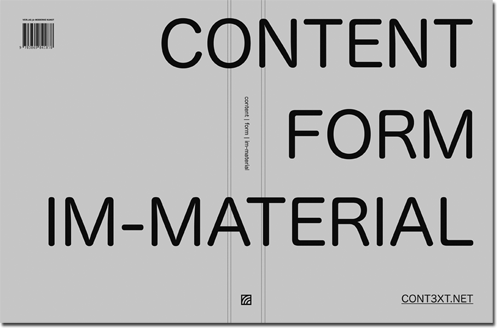
Curating, Communication & Open Source:
Interference — New Media Space | Forum #003

Edited by Sabine Hochrieser, Michael Kargl, Franz Thalmair
view original context
The Internet — on the one hand — blended seamlessly into our life. Internet Art — on the other hand — stayed separated from the “art scene”. What causes this separation? As often stated by people working in this area it is first and foremost the “classical art field” that is unwilling to look over its own borders and to recognise art that incorporates (new)technology in general. But this argumentation reveals only the first in a series of problems emerging from viewing and reflecting Media and Internet-based Art from the “inside”: the focus on technology. This focus opened doors in the nineties when technology — and especially the Internet — promised several utopias. But now it is a boarder closing off the outside world. Often enough technology is covering the weakness of artistic projects or is — even worse — the solely focus.
Post by qui que?
On Tue Oct 21, 2008 12:29 am
Throughout the past three decades, as you well know, we have experienced an explosion of activity in “new media art” and the general social and industrial implications there of. Many voices have reiterated the statements made in the mid 70′s (by the likes of…) over the necessity for reflection in so called radical productions by adaptation and incorporation within the institutions, museums, exhibition galleries and organizations which deal, or in their nature should deal with the new cultural practice – broken it’s banks in response to an implosion of a relative opposition. Streaming in torrents of metamorphosis through hidden architectures of code. Swelling in algorithms past mills, driving the mechanisms of actual and imaginary machines, then to a net of organic modulation; falling from interaction towards symbolic uprisings from a social terrain to seep, trickle and flow again into the reactions of inspected expressions, in the contemplative float of another, speculatively processing a culture machine without any unification of adhered or imposed agenda.
In further cultural reflection national museums invest in collections of computers, form viewing salons and digitise their archives – actions, more than often separate to their experimentation with and implementation of representative web-sites and online galleries, many of which are now abandoned.
The screen can be found as the overlying interior throughout that classified as net.art. This presents an awkward obstacle for the curator, the technical complications in satisfactorily dealing with any audio counterparts or control units without imposing a intimate interaction, in contrast to the ambient privacy of other mediums in their socialisation. Is the net.art genre then not as such a mode of gallery art, but a different form of creative expression.
A TV or magazine ad can often be as creative or as rich in content as any artwork. Such works are not developed for the exhibition space, but for an intimate consumption in a both virtual and physical, personal space. To exhibit materials of such forms the effort must be made on the behalf of the curator; appropriating the different mediums throughout any selected material, through individual correspondent techniques into a cohesive whole, fit for public display.
Muha’s sketchbooks can be seen in his museum in Prague, likewise with Van Gogh in Amsterdam and Makintosh in Glasgow, but such curational techniques are in display of the intimate thoughts of gifted or renound minds. To continue from this state of creative exercise, a part of the developmental process traditionally, where in order to progress, the artist must reconcile between concept and space, making custom developments of their practice towards the targeted space for exhibition. In movement contra to the digitisation of productions fitting the traditional ambient, for archive and display then, in a place between youtube and the magazine arises a need for the development of inventive techniques toward the reformation of the different limitations towards the exhibition of .net and new media arts, spacial installations, contemporary performance and other new emergent forms.
Post by hight
On Wed Oct 22, 2008 8:37 am
… and there is also the long running debate as to what constitutes “new media” as it has progressed along certain cores and new platforms for time lines that depending on who is talking can range from 20 to 100 years. Even the trope of “avant garde” is seen by some as experimentation with new media, tools and technologies and can be traced much farther back. Some question the name , while others question the questioning itself.
There have been pronouncements of new media as “dead” for years alongside declarations of its impending break from the contextualization of the museum system’s sort of baby brother. This winds on today and surely will for longer to come.
There was an interesting discussion last year online connected to workshops at Cambridge on what future sort of interactions and interface lie ahead for exhibition of both “screen based” work and more traditional physical works with new forms of augmentation. Very interesting.
It was also very interesting to note several prominent voices in the discussion that were architects working in interface design and theory taking elements of architecture and architectural theory into spatial visualizations of information and spaces for exhibition
Post by carlos
On Wed Oct 22, 2008 9:14 pm
maybe the screen is just a temporary artefact that will be obsolete soon. i don’t think of holodecks here, but of some kind of transformation: what you, jeremy, mentioned by pointing at architects that are working on the border between space and screen (and which actually are often expanding the screen to become architecture and vice versa) is a process that currently can be found everywhere: the borders between reality and “virtuality” are blurring more and more (sorry if this sounds like bad-late-nineties-talk). so to me the question is: isn’t net art already outdated? or to say it the other way round: if you’re still devoted to net art (which is kind of a statement i would say) is it still possible to stay on the net only? sure, i think the net is still a very important material to work with/in but more important is it to go a step further and to connect it to reality. and exactly this is the process where i would like to go deeper: is it possible to do -as curator or artist- some kind of translational work in setting up net art in real space? what does it mean to lose the original context (the private surroundings of people looking at net art at home, the (normally) one to one communication of artwork and spectator, etc.)?
Post by fratha
On Fri Oct 24, 2008 12:39 pm
well, i think if you are concerned with the internet you must develop your artistic practices in the online medium and in a netwoked environment. otherwise it wouldn’t be internet art, internet-based art, internet-aware art, net.art or whatever further term may describe what is going on there. the thing is, that despite all anti-institutional habits, artists should be at least open for the translation of their works for the exhibition space.
i guess it is not possible to show a 1:1 replica of the artwork in a museum as there are so many different impacts on it within the structures of the internet. but, there is always, one curcial point the artwork is dealing with or the artist wants to talk about / to comment on. the transformation from virtual to real can be developed around the key issues of the work, as a sort of extract or summary which fouces on only one single point, the essence of it. of course, this is a a single dimensioned way to deal with the whole subject and perhaps over-didcatical for the spectator. but perhaps those methods can even open the work for new contexts and new developments …
Post by carlos
On Sat Oct 25, 2008 9:13 pm
fratha wrote: “the thing is, that despite all anti-institutional habits, artists should be at least open for the translation of their works for the exhibition space.”
yes, but this seems to be a strong no-no nowadays – or am i wrong here? this leads me to ask: is this still a curatorial process or an artistic one? could this lead to a new “curators-as-artists” class as we had in the 19nineties?
or should these classifications be dropped in favour of a new model of curating – an open process of conversation (be it material or non-material) between an art-expert (the artist) and an exhibition-expert (the curator). maybe also including others like space-experts (architects), style-experts (designers), text-experts (authors) etc. ?
Post by qui que?
On Mon Nov 10, 2008 3:27 am
in reference to carlo’s poses on specialism and after some years in the contrary, i have begun to swing back to ideas that artists are not suitable curators.. however for me the artist, the theory junky, the technician; the arts events coordinator; the term new media does not speak about a movement, but rather makes a reference pertaining towards work which experiments with new medias. much of the contemporary new media art is classifiable as digital art, new media art is also very much existent in scientific art, or biological art – because of the new developments in science, though consider that working with a classification such as scientific art or digital art would be as general as forming a collection of “paintings.” how does new media art hold in this mode?
digital art, as epoch in the avent guarde of new media work, along with scientific arts, should be more closely studied inorder to derive the specific movements there in, held in consideration next to other relevent counterparts in other areas of new media work (as opposed to stylistic revolutions within older mediums ?). is the furtherance of revolutionary or activist work born by digital culture, a viable part of the pre exhisting movements (are the cubist paintings and collages made by children in schools a further tale-end part of the cubist movement ?) in this new cybic understanding there seems to be a general tendency away from the movement and towards the various human tendencies in motivatoin within the various styles and mediums available at the time. then what distinguishes a true movement in art history is the matter which is discovered, the heart of an ideal, or an unmovable truth. have they found something at VISUALIZAR, at CODED CULTURES, or is it still to early to be able to see the movements of our times ?
Post by carlos
On Sat Oct 18, 2008 4:49 pm
the border between the work of an internet artist and the curating done by a curator who wants to show the work in a physical exhibition is shifting. it is not enough to put computers in an exhibition and let artworks be on display. internet works have to be adapted to be shown in an exhibition space. since the original context of those artworks -the private surroundings of people consuming internet art on their computers at home- is lost, there has to be some kind of setup that makes the work suitable for the gallery-context. on one hand this is the responsibility of the curator -(s)he is the one who provides the exhibition context- but on the other hand it is also the responsibility of the artist to think of possibilities how the pieces can be transformed. thus a intense communication process is needed between curator and internet artist.
my questions now are: what do you think about this? where should the border between the artist and the curator be located? where does a curating-process start? and why would anyone want to show internet-based art at all?
Post by hight
On Mon Oct 20, 2008 10:17 pm
Great question. I wish to be just one voice in a crowd here as to me it is a subjective context in several ways but quite important. I published a paper last year titled “Immersive Sight” that looked into new hybrids of real and “virtual” or real and “networked” etc as a possible range of new forms of exhibition including possible exhibitions of art that were a physical work and a networked one but in a kind of dialog or with augmented reality the possibility also of “online” works also being seen in a physical space devoid of a computer and screen etc.
There are works that comment on the net , interface, social networks, screen, semiotics of computing etc that work well online or on screen while there are others that reference Marcus Novak’s concepts of eversion and there is a growing need for works to be both in the screen based and physical as a dialog and commentary on spatiality, form, architecture and interface and many other areas. I have been an online curator as well as an artist working in screen based work and locative media so to me there are about a hundred crossing trajectories at hand here.
Post by qui que?
On Tue Oct 21, 2008 1:14 am
Recently I’ve been stuck thinking about the idea of contents in the context of exhibiting net.art in a way which is reflective of suitable rêverie appropriée. Wall “tagging” for individual works for example, considering the rerepresentation of modes in notation with regards to the nature of the work, by way of material or technique, architectural or aesthetic reference. Is there a liniar phasing of genre or style which is represented in the shifts both effecting net.art and occuring within net.art. Are such traceable phases related with any particular cultural or social ideals and structures.
Post by fratha
On Fri Oct 24, 2008 12:52 pm
in his introductory interview to the book “curating subjects” paul o’neill is saying that curating is: “an adaptive discipline, using and adopting inherited codes and rules of behaviour.” For online curators (who, for me, are not only curating on the internet, but also Internet-based art offline) this quote is quite suitable. the curator of internet-based art is working i n and w i t h i n the same medium as the artist does. despite all curatorial storytelling and the development of new ideas, theories and contexts, the curator is working on behalf of the artist and his work. so: no curators without art, no curators without artists! (O’Neill, Paul / Fletcher, Annie: Introduction: Paul O’Neill interviewed by Annie Fletcher. in: O’Neill, Paul (Ed.): Curating Subjects. Amsterdam: De Appel, Centre for Contemporary Art. 2007. 109-122.)
-