Re:Interview #010:
Writing about Zeros and Ones | Josephine Bosma

At the 3rd Inclusiva-Net Meeting in Buenos Aires in March 2009, the Amsterdam-based writer and critic Josephine Bosma presented the synopsis of her activities as a Net Art critic during the past fifteen years. In her lecture entitled “Radical Diversity – The Confluence of Art and the Internet” she propagated a strongly interdisciplinary approach to Net Art criticism, which reaches beyond a purely literary, Conceptual Art criticism. In the introduction to her talks Josephine Bosma writes: We now see the fifth generation of artists who work with computer networks. Of these five generations four worked with the Internet, and one (the first) worked with forerunners of the Internet. Current, popular definitions of net art do not describe the plurality of approaches and methods these artists used and still use. They have become limiting obstacles that block our view of this wonderfully complex terrain of mixed conceptual and material art practices. Mainstream art discourse generally fails when assessing net art by confusing it with web art. At the basis of this misinterpretation lies a lack of knowledge of even the basics of new media.
Any recommendations for a current piece of Net Art worth being browsed?
My favorites at the moment are the recent works of two art groups that originate in the nineties net art scene, and one ‘newbie’. These are first of all Jodi with GEO GOO, more specifically the first version that was presented at iMAL in Brussels in autumn 2008. It has added an uncanny and untypical form of performance to their already unique approach. Another project I am following with great interest is etoy.CORPORATION’s Mission Eternity, which borderlines somewhere between megalomaniac madness and sheer brilliance. The last one is a relatively young Dutch artist, Constant Dullaart. His work ranges from ‘traditional’ conceptual art and installations to what Marisa Olson might call ‘pro surfer’ art, artists that use web 2.0 features to make art and exchange ideas. His The Artist is a Creator of Beautiful Things (interestingly not filed under internet works on his site), speaks of a great sense of humor and self-criticism to me. I am very curious as to where he will go from here.
You are writing about Net Art since the early beginnings in different formats such as radio documentaries, reviews, interviews and essays. Which changes did Net Art criticism go through during the past fifteen years?
I love that you file my radio documentaries under ‘writing’. Recording is of course a form of writing, of inscription. We have developed new ways of sharing knowledge, and not everybody recognizes them. The most important change in net art discourse is directly connected to this. There was always the fear that net art would become institutionalized to the extent that it would die as a vital art practice. This did not happen, even if the field has been extended into some major art institutions such as the Tate or the Guggenheim. What was underestimated in the mid nineties however was the way net art would be picked up by academia. The academic system is largely made up of paper. It does not recognize any digital publication as a source.
Online discussions and publications were the most important form of discourse around net art for a long time. Even if there have been many good book publications in this area since the end of the nineties, most of contemporary net art discourse still happens online (of course). It is quite absurd that a quote from a paper magazine is valid, whereas a quote from an online magazine is not. It creates a schism, and it distorts the field in a way that is much more influential than the net art activities of art institutions do. Luckily there is some restoration of the balance through the involvement of many ‘cross-over’ writers, people who have come from online publications and are now also working for magazines and universities and vice versa. I witnessed discussions about the validity of digital publications for at least ten years now, and I am very curious when changes will finally come. A friend of mine is engaged in a subtle protest by not sending his PhD text to his university in paper format. He won awards for his PhD dissertation, made it available for free online, but technically he still has not been promoted. This will not happen until that pile of paper lands on somebody’s desk.
We live in an age of sharp contrasts. I like the experiments with open source writing that happen, like McKenzie Wark’s Gamer Theory (in which the writing process was public and open for immediate comments) or the project Networked – a (networked_book) about (networked_ art) by Turbulence.
In your lecture you where referring to a “critical blind spot” of art using non-traditional media which is discursively crippled by a rejection of its material properties. Does this mean that the focus of nowadays Net Art criticism has to be put more on technology?
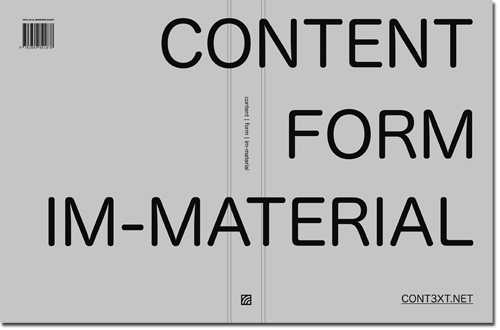
The material properties of this art consist of more than just individual pieces of technology. Net art is an extension of the field of interdisciplinary art practices. New technologies do pose the biggest challenge in this mesh of material properties though, and in order to escape dealing with it I see some critics choose for a simple dismissal of their role in the work. Already in 1962 Susan Sontag criticized the separation of form and content in art. In order to understand and describe these works, you cannot avoid looking at them in their entirety, and with a technology you do not really understand or cannot work with yourself being part of the work, this can be difficult. This issue has of course many different aspects, of which some are absolutely logical consequences of the complexity and ‘newness’ of the technology involved. These aspects are relatively easy to address.
It is clear that as people get more knowledgeable about new technologies and their cultural context they will be able to ‘read’ more deeply into a work in which these technologies are used. As it will become evident that art in new media is radically diverse, ‘specialists’ will develop in certain areas that are able to describe and contextualize specific works profoundly, as is also the case with art in general. This is already happening in fact. We see the development of critics that have a deep insight in software art, who are able to judge different aspects of code and software in an art context. On the absolute other side of the new media spectrum research and specific criticism is being developed around the phenomenon of urban screens. The work that is being done in these areas is incredibly valuable for the disclosure of art in new media to a larger art context.
On the other hand I have noticed a tendency to deny the specificity of new media and especially digital media in some traditional art circles, not as a way to criticize the works, but as a way of not having to deal with them at all. Such an attitude is different from critics who are willing to open up to a work of art they find difficult to read, but who simply still need to find their way in. With downright hostile critics there is no profound discussion about the works in question, not even the slightest attempt at accuracy. There is no recognition of ‘digilliteracy’, no willingness to be concerned with the aesthetics and context of these new materials. It is a tendency that puzzles and worries me. In my lecture I mentioned Bourriaud’s open and fierce hostility toward media art during an evening about interactivity in Amsterdam. It is hostility without foundation, without even the slightest form of argumentation, the only argument literally being “I don’t talk about media art because there is no good media art”. The shallowness of such an approach should absolutely be addressed, and for me it is a reason to continue using specific terminology for art created with new technologies, like net art or media art, instead of just art alone. I want to call out the beast of ignorance. (I secretly call Bourriaud’s view on art High Mediocrity by the way)
Does the language used to criticize Net Art cause the still ongoing separation from mainstream art discourse?
Despite a growing number of writers who work across different contexts, criticism of net art is still roughly divided in two areas: that of the traditional art world, and that of the online communities. I have talked about the traditional art world in my previous answer. When it comes to online net art criticism we are dealing with a heritage of outdated notions of net art, which have taken on a life of their own. They can be obstructive. One of these is the idea that net art is about criticizing and deconstructing the Internet. Another one that is related to this is that net art is anti-institutional.
There was and is of course a big overlap between the interests of media activists, hackers and artists: they all want as much freedom as possible to explore and use a medium. Pursuing the freedom to create a work of art and keeping control over it (or not) within the context of the Internet is a very interesting undertaking, and not just from a technical point of view. Yet this challenge has come to be perceived as the central issue in net art, the only issue even for some critics. The biggest mistake they made was declaring net art dead when it would not live up to their ideological projections.
The truth is however that net art practices are incredibly diverse. I called it radically diverse in my talk. There is not one true way to make net art. The Internet, or new media in general, is used in an abundance of ways in all kinds of art practices, often creating amazing crossovers and interdisciplinary wonderlands. Reducing net art to an ideological routine, or by claiming it is browser based (another extremely limiting view), obscures and neglects a huge range of art out there.
What do you mean when you mention that nowadays not only the artwork, but also the art discourse has become deeply interactive and unstable?
Like newspapers and television have found competition and additions to their work in blogs and other Internet platforms, so have art institutions and art magazines also been confronted with a whole range of critical and opinionated voices online. This takes some time getting used to, and I would not be surprised if the digital versus paper divide also hinders a full realization of what this extension of the critical debates outside of the regular art publications means. Some traditional art magazines and institutions have opened their websites up for discussions by the audience. As I have shown at my talk however the websites of traditional art institutions and magazines still tend to be constructed as islands, whereas online magazines will be linked to a larger network.
Why did you recommend the piece of Net Art at the beginning of our interview?
The works I mentioned all make me curious for more. With Jodi it seems as if they have started to apply the same scrupulous and almost psychedelic deconstructive approach they used on software and the Internet to a much broader experience of being networked. After first including the street with webcra.sh, they have zoomed both in and out with GEO GOO. This project connects the weirdness of googlemapping the planet with an over-sensitized yet depersonalized body. It seems to add a very subtle layer of anxiety, which I have not seen in a jodi work before.
Mission Eternity deals with death, but is not frightening of frightful at all. The basic principle behind it, the Angel Application, is still under development, but is already incredibly strong as a concept. To have files replicate and migrate themselves is an amazing idea in the context of personal and cultural heritage. The use of freight containers as a kind of network standard is also very good. The containers seem to at the same time symbolize the confinement of cyberspace and its ubiquity. I think Etoy is one of the most daring art groups around, and I admire their stamina. It is not easy getting a (very) long-term project like this one, which includes anything from code art to installation and performance, supported.
Constant Dullaart is of a totally different order. In some ways he still has to proof himself, certainly compared to the other two. Many of his Internet works, and also some of his installation works, are made up of very simple gestures. They seem like sketches, finger exercises, random but smart experiments. It is fascinating to see how easily he switches between media and roles (curator, artist, critic even maybe). Combined with his eye for detail this makes him someone to watch.
Thank you very much for the interview!
-